10 terms you need to know before digitalising school transport
Digitalising school transport is not simply about replacing paper with an app. Before choosing a solution, it helps to understand a few key concepts.
Digitalising school transport is not simply about replacing paper with an app.
It means changing the way routes are planned, teams are coordinated, families are informed and everything that happens on each journey is monitored.
For a school, a transport company or an organisation that manages school routes, technology can become a key tool for improving the efficiency and safety of the service.
But before choosing a solution, it is worth understanding a few concepts.
In this article we explain 10 terms related to the digitalisation of school transport that every transport manager should know.
In this article
Route management is the set of processes needed to organise and control passenger transport.
In a school setting it includes much more than deciding which streets a bus travels along. You need to manage:
- Vehicles
- Drivers
- Escorts
- Students
- Stops
- Timetables
- Routes
- Services
- Incidents
- Last-minute changes
- Information for families
When all this information is managed manually, it is common to work with spreadsheets, documents, phone calls or messages between different people.
The problem appears when the number of routes and passengers grows. A change to a stop can affect the timetable. A driver may be unavailable. A student may need to use a different route for a few days.
The digitalisation of route management makes it possible to centralise all this information so that the different people involved work from the same data.
The goal is not just to have more information. It is to be able to manage it faster and in a more coordinated way.
Route optimisation consists of finding the most efficient configuration for carrying out the different journeys.
In school transport, this may involve analysing variables such as:
- Number of students
- Stop locations
- Start and finish times
- Vehicle capacity
- Journey duration
- Distance between stops
- Vehicle availability
- Driver availability
- Service restrictions
A seemingly simple route can have many variables behind it. For example, adding a new stop does not only affect that stop: it can change the total journey time and affect the stops that follow.
That is why optimisation makes it possible to move from planning based mainly on experience to planning supported by data and operating rules.
Why does it matter?
A better-planned route can help reduce unnecessary travel, make better use of vehicles and make it easier to keep to timetables.
Optimisation does not necessarily mean making the route shorter. A route may need to be slightly longer in order to meet timetables properly, pick up all passengers or respect certain restrictions.
The key is to find a balance between efficiency, capacity, timetables and passenger needs.
Geolocation makes it possible to know the position of a vehicle using location technologies.
In school transport, this information can be used to know where a bus is during a route. This changes the way the service is managed.
Without location information, a coordinator may need to call the driver to find out where the vehicle is. With geolocation, the information can be available directly in the management platform.
It also makes it possible to provide information to families. For example, while a bus is carrying out its route, an app can show information about the status of the route.
Geolocation can also help analyse the service afterwards. It provides information about the journeys made and helps detect possible deviations from the plan.
Geolocation does not simply mean "seeing a bus on a map"
Its real value appears when location data is integrated with the rest of the service information. Vehicle, route, stops, timetables and passengers can all be part of the same system.
In school transport, real time means working with up-to-date information while the service is taking place.
This is especially important because a route does not always unfold exactly as planned. The following may occur:
- Traffic
- Delays
- Stop changes
- Incidents
- Absences
- Driver changes
- Route modifications
If information takes time to reach the people responsible, the ability to react decreases. A digital platform allows certain actions and changes to be communicated much more quickly.
For families, this also has a significant impact. Receiving information after the bus has arrived is not the same as knowing about a delay while the service is under way.
Real-time information turns transport into a service that is more transparent and connected.
Knowing which passengers use a route is essential. But it is also important to know when and where they get on or off the vehicle.
Boarding and alighting control makes it possible to record these operations digitally. In a school service, this can provide an additional layer of information about each student's journey. For example:
A student is assigned to a particular route and stop. When the journey begins, their boarding is recorded. When they reach their destination, their alighting is recorded.
The information is linked to the service. This makes traceability easier and reduces reliance on manual processes.
It can also help the teams responsible for transport check what happened during a route.
Less paper. More information.
When these processes are carried out using paper lists, information can end up scattered. With a digital solution, records can be centralised and consulted later.
This is especially useful when managing many passengers and several routes at the same time.
Families are a fundamental part of school transport. However, they have traditionally had limited visibility of what happens during a route.
A school transport app for families can centralise information related to the service. Depending on the solution used, it may include features such as:
- Route information
- Assigned stops
- Timetables
- Alerts
- Notifications
- Service status
- Boarding and alighting
The main advantage is that communication no longer depends solely on phone calls, emails or individual messages. Information can reach the family's device directly.
Communication is also part of the service
Transport management does not end when the bus leaves the school. Families need to know what is happening and receive information when there is a relevant change.
A good digital solution should make this communication easier without adding unnecessary work for the transport team.
On-demand transport is a model in which the service adapts to the real needs of passengers.
Instead of always operating with a completely fixed configuration, routes or services can be adjusted according to demand. This concept can be especially interesting in certain school transport services, but also in other areas such as:
- Employee transport
- Day centres
- Care homes
- Charter transport
- Special services
Imagine a service in which certain passengers do not use transport every day. If the system knows in advance which people need the service, planning can adapt to that demand.
This can help avoid underused resources and improve planning.
However, on-demand transport requires more than an app. It needs information, planning and coordination capacity.
Schools already use different platforms to manage their activity. Transport should not become an isolated system.
System integration consists of connecting different applications so that they can exchange information.
For example, a school may use an educational management system and, at the same time, a platform specific to transport. When both systems are integrated, certain data can be used in the transport service without having to enter it manually several times.
This is especially relevant for educational platforms such as PowerSchool or iSAMS, which may be part of a school's technology ecosystem.
Why does it matter?
Because entering the same information into different systems increases workload and can lead to errors. Integration aims to let systems work together.
The ultimate goal is to create a connected digital ecosystem, instead of having different tools that work independently.
We come to one of the most important concepts.
Digitalising school transport does not simply mean using an app.
It means transforming processes that have traditionally been carried out manually so that they are managed with digital tools. For example:
The difference is not only in the format. It is in the way of working.
What can digitalisation bring?
A well-designed digitalisation strategy can help to:
- Centralise information
- Reduce manual tasks
- Improve coordination
- Make communication easier
- Obtain up-to-date information
- Record operations
- Detect incidents
- Improve traceability
- Support decision-making
But digitalising does not mean automating absolutely everything. Some processes require human intervention.
That is why a good platform should make the work of the people who manage transport easier, not more complicated.
Traceability is the ability to know and record what has happened during a process. In school transport, this is particularly important.
An operation can generate different data:
- Which route was carried out
- Which vehicle carried it out
- Who was driving
- Which passengers were assigned
- Which passengers boarded
- Which passengers alighted
- Which stops were made
- Which incidents occurred
- When certain actions took place
When this information is recorded digitally, it is possible to consult the service history afterwards. This provides a much more complete view of the operation.
From planning to history
Traceability makes it possible to connect different moments of transport:
Planning → execution → recording → analysis
It is not only about knowing what should have happened. It is also about being able to know what actually happened.
This information can be used to improve future planning and to detect recurring patterns or incidents.
Why is it important to know these terms?
Digitalising school transport involves making technological and operational decisions. That is why, before comparing platforms, it is worth understanding what the service really needs.
Not all solutions offer the same features. And not all organisations need the same thing.
A school with several routes and hundreds of students may have different needs from a transport company that manages services for several schools.
So, rather than looking for a tool that includes many features, it is important to analyse how technology fits into the real operation of the service.
Questions to ask yourself before digitalising transport
How do we currently manage routes?
If the answer involves several spreadsheets, documents and communication channels, there is probably room to centralise processes.
How do we know where our vehicles are?
The answer helps determine what role geolocation should play.
How do we communicate delays to families?
This helps assess real-time communication needs.
How do we record boarding and alighting?
This is where passenger traceability comes into play.
Are our systems connected?
If the school uses other platforms, integration can become an important selection criterion.
What happens when a route changes?
The ability to quickly modify planning is a fundamental part of day-to-day management.
School transport is evolving
For years, school transport management has relied heavily on the experience of coordinators, drivers and administrative teams. That experience remains essential. Technology does not replace it.
Technology makes it possible to place that experience in a more connected environment, where information is available and the different teams can work in a coordinated way.
The result is a transport model in which different players take part:
A school transport platform must connect all these players without making their daily activity more complex.
BatOnRoute: a platform for digitalising transport
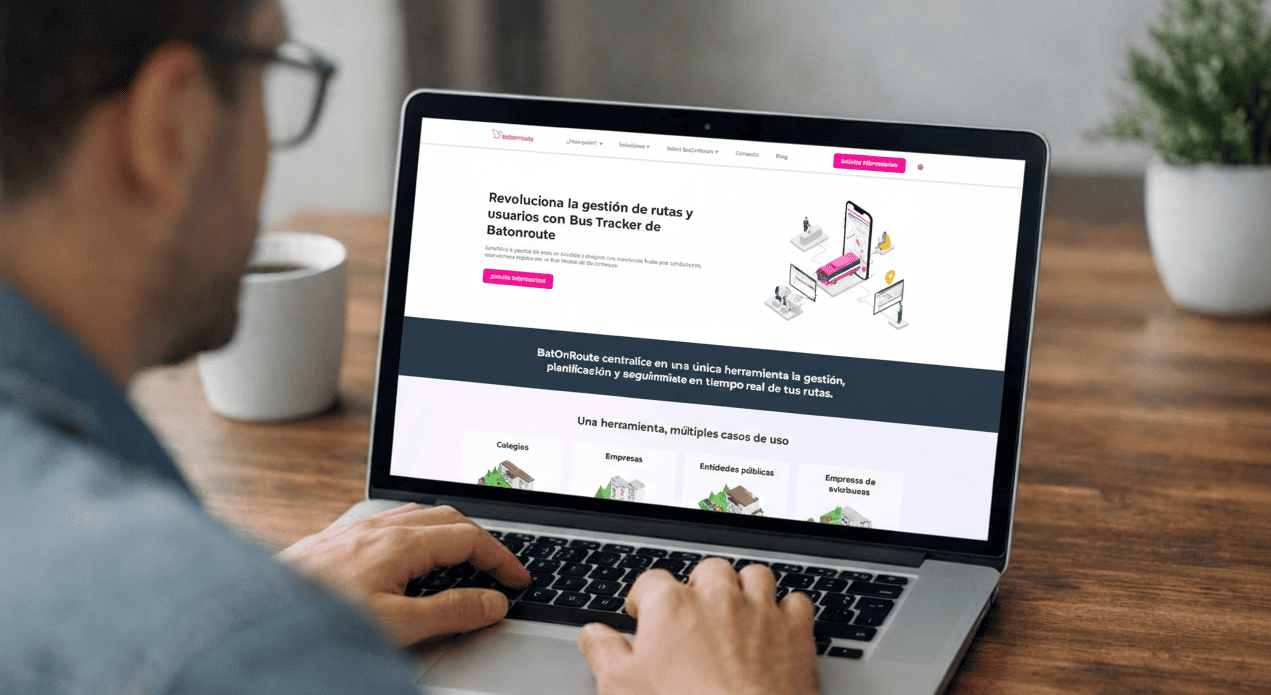
BatOnRoute is a school and employee transport management platform that connects schools, transport companies, drivers, escorts and families.
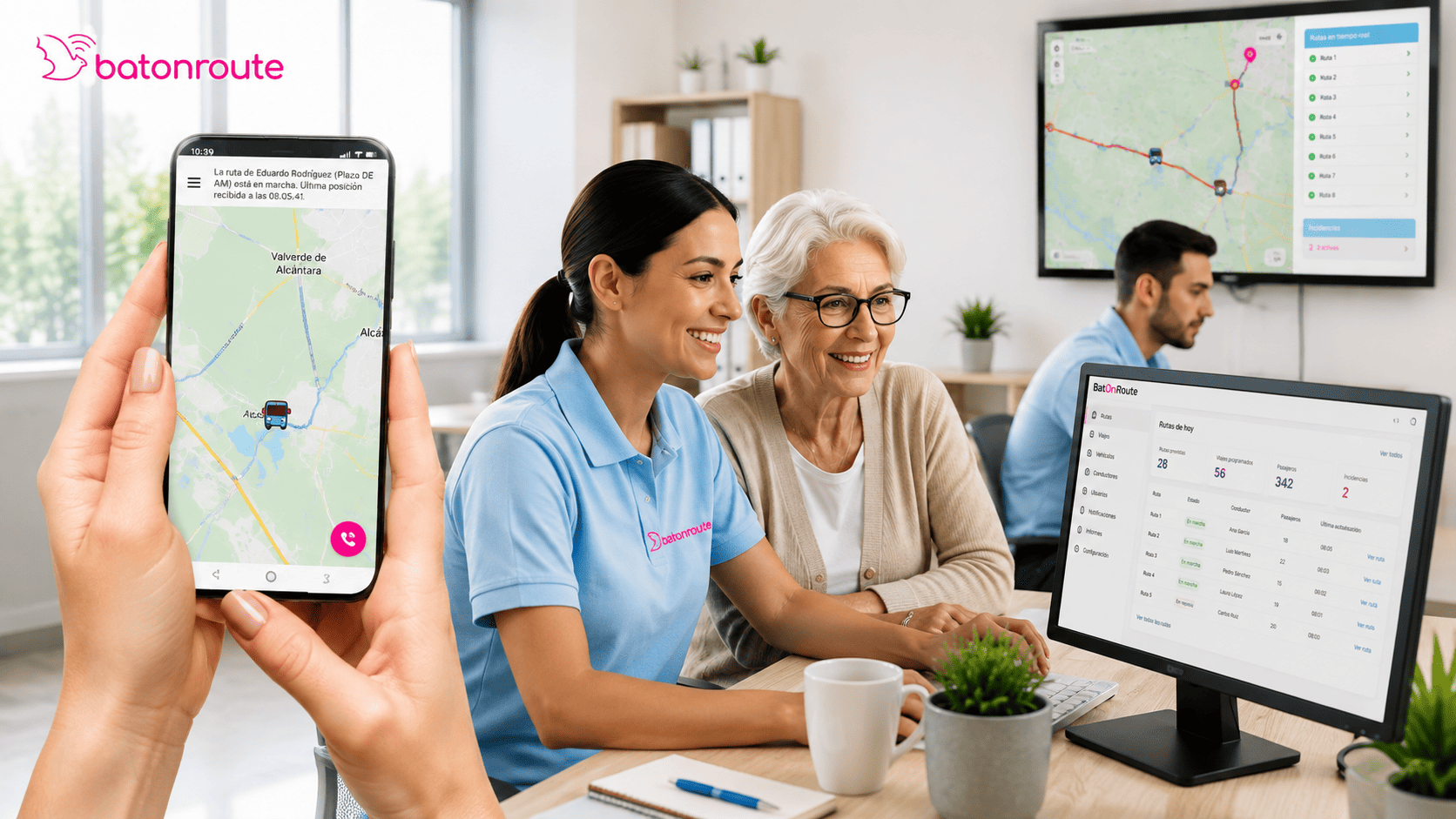
The platform lets you manage transport operations from a single environment. This includes planning and managing routes, passengers and teams, together with communication and information tools for families.
BatOnRoute also offers apps for the different users of the service and can integrate with systems used by schools, such as PowerSchool and iSAMS.
Technology should adapt to the service. Not the other way round.
That is why the aim of a transport platform should not be to add more tools to a school's day-to-day work. It should be to reduce management complexity and make sure everyone involved has the information they need, when they need it.
Conclusion
- Route optimisation
- Geolocation
- Real time
- Boarding control
- Family apps
- Integration
- Traceability
They are different concepts, but all are part of the same transformation: that of connected, digital transport.
Understanding these terms is the first step towards assessing what an organisation really needs and which technology can help it improve its service.
Because digitalising school transport is not about having more technology. It is about managing information better, coordinating people better and delivering a more efficient, safe and transparent service.
Want to see how BatOnRoute works?
Find out how you can digitalise the management of your school routes and connect everyone involved in the service from a single platform.
Discover BatOnRoute →