How to manage school transport: a guide to improving safety, organisation and communication
Routes, attendance, bus tracking and communication with families: what a school needs to digitalise its transport service.
Managing school transport is one of the tasks that demands the most coordination within a school. Every day, hundreds of students may use different routes, stops and buses, which means organising timetables, monitoring attendance, coordinating drivers and monitors, and keeping families informed.
When these processes are handled with spreadsheets, phone calls or scattered communications, it becomes harder to get a complete picture of the service. Last-minute changes, absences, delays and incidents can create a significant administrative burden for the school.
But how can a school manage its transport more efficiently? What technology does it need? How can it improve student tracking and communication with families? In this guide we explain the fundamentals of organising school transport, the most common problems and the technology solutions that improve day-to-day management.
1. What does a school need to manage school transport properly?
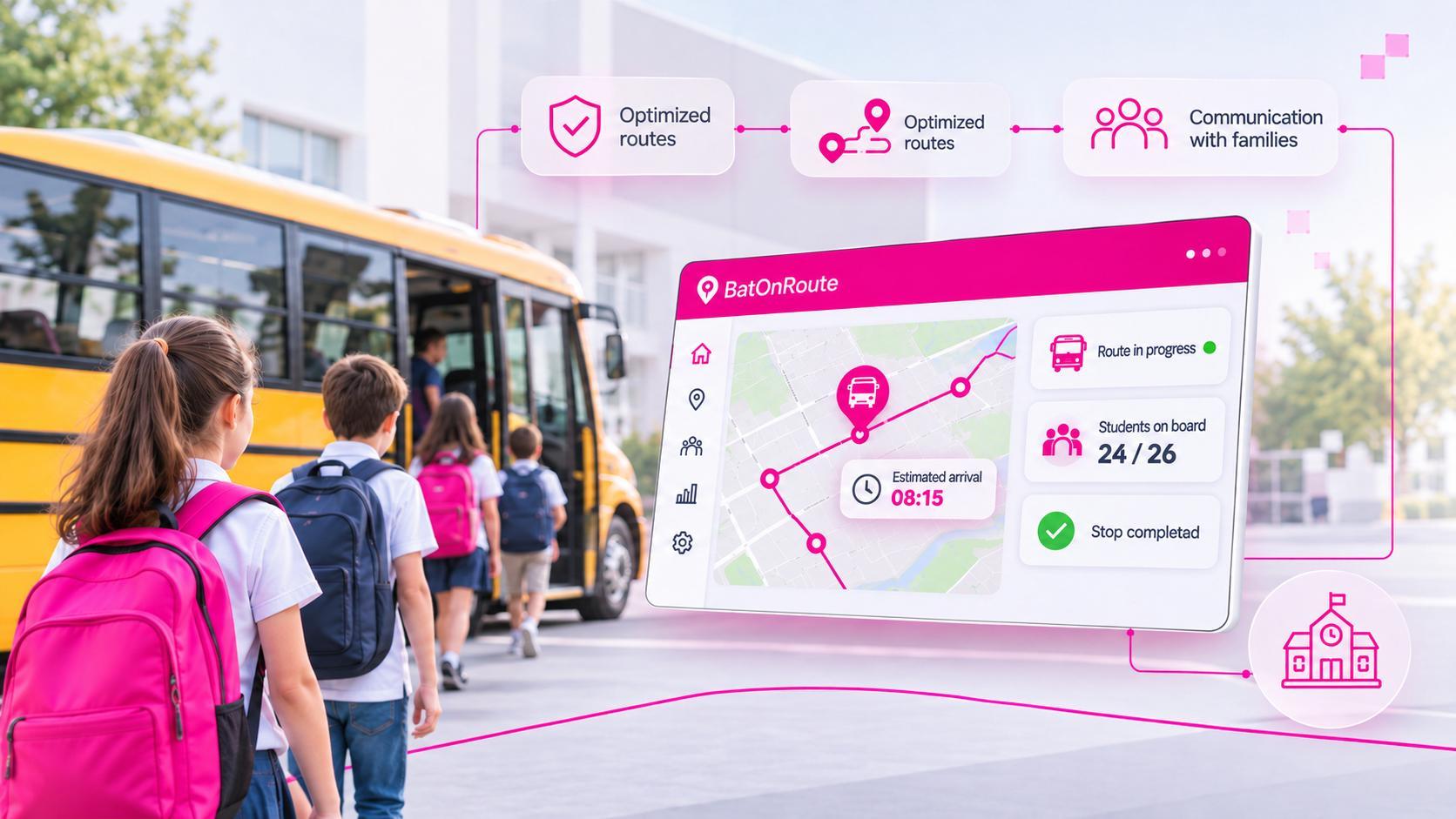
Managing school transport is not just about designing routes and setting timetables. It involves coordinating different people, vehicles and processes so that the service runs smoothly throughout the school year. A transport management system should cover, at a minimum:
- Route and stop planning: organising routes, assigning students to each stop and distributing them across the different buses.
- Attendance control: knowing which students use the service each day and recording when they board and get off.
- Vehicle tracking: checking where each bus is and the status of each route.
- Incident management: communicating delays, route changes, absences or any unexpected event.
- Communication with families: providing up-to-date information on schedules and transport status.
- Staff coordination: making the work of drivers, monitors and transport managers easier.
Centralising this information reduces manual tasks, improves coordination and provides reliable data for decision-making.
2. What are the main problems with traditional school transport?
Many schools still use manual procedures to manage part of their transport. Although these can work when the number of students is small, they become difficult to sustain as the service grows more complex.
Lack of visibility over routes
When the school has no up-to-date information on where the buses are, it is hard to know whether a route is running on schedule or whether a delay has occurred.
Manual handling of absences
Families may report that their children will not take the bus by phone, email or message. School staff must collect this information and pass it on to those in charge of the routes.
Slow communication with families
Delays and last-minute changes generate a large number of enquiries. Without a centralised channel, informing all affected families can become a complicated task.
Difficulty monitoring boarding and drop-off
Knowing which students have boarded the bus and which have reached their destination is essential for keeping proper control of the service.
Inflexible planning
Changes to timetables, stops or routes can force part of the planning to be redone manually, especially when there are several routes and vehicles.
Digitalisation addresses these problems through tools that centralise information and automate part of the daily tasks.
3. What is school transport management software?
It is a digital platform for planning, supervising and administering students' journeys between their homes and the school. These tools connect the different participants in the service: schools, transport companies, drivers, monitors and families.
It usually includes features such as:
- Route planning and optimisation.
- Management of students, stops and vehicles.
- Real-time GPS tracking.
- Attendance control and passenger registration.
- Mobile apps for families and transport staff.
- Automatic notifications about delays and incidents.
- Reports and statistics for those responsible for the service.
The aim is to have a single platform from which to view school transport information and coordinate how it runs. Not all solutions offer the same capabilities, so before choosing a tool it is important to analyse the school's specific needs and the transport model it uses.
4. Features a good school transport software should have
When choosing a technology solution, pay attention to the features that have a direct impact on daily management.
Real-time GPS tracking of buses
It shows the location of vehicles while they are on their routes. This information helps the school supervise routes and allows families to check the bus status and its estimated arrival time at the stop. It also makes it easier to detect delays and improves the ability to respond to unexpected events.
Digital attendance and passenger control
Recording boarding and drop-off shows which students have used the service and when. With mobile apps, monitors can log passenger movements and share that information with the school and families, depending on how the service is set up.
Absence and route change management
Absences and occasional changes are part of the everyday operation of any school. A digital platform lets you record these changes, update student information and communicate the changes to the people responsible.
Automatic notifications to families
Communication is one of the most important elements of school transport. Family apps can send alerts about:
- Route delays.
- The bus approaching the stop.
- Student pick-up and drop-off.
- Changes to the planning.
- Incidents during the journey.
This way, families have up-to-date information without having to call the school constantly.
School route optimisation
Route planning can become a complex process when there are many students, different pick-up areas and time constraints. An optimiser calculates routes taking into account variables such as:
- Student locations.
- Distance between stops.
- Vehicle capacity.
- Maximum journey time.
- Boarding and drop-off times.
- Fleet availability.
The result is more balanced planning, with the potential to reduce kilometres driven, journey times and operating costs.
5. How can student safety be improved during school transport?
Safety should be a priority criterion when organising student transport. Technology can help improve control and traceability of the service through several mechanisms:
- Passenger identification: control systems record which students board and leave the bus, making attendance easier to verify.
- Record of pick-ups and drop-offs: makes it possible to check when each operation took place.
- Route tracking: geolocation makes it easier to know where the vehicle is during the journey.
- Incident communication: notifications inform managers and families when delays or changes occur.
- Activity history: keeping records of routes, attendance and incidents helps improve supervision and analysis of the service.
Technology does not replace the supervision of drivers, monitors and transport managers. Its role is to provide better tools to coordinate the service and have more accurate information.
6. How can communication between the school and families be made easier?
Families need to know that their children have arrived at school safely and to have information when there is a change in transport. However, handling the enquiries of hundreds of families individually places a heavy load on administrative teams.
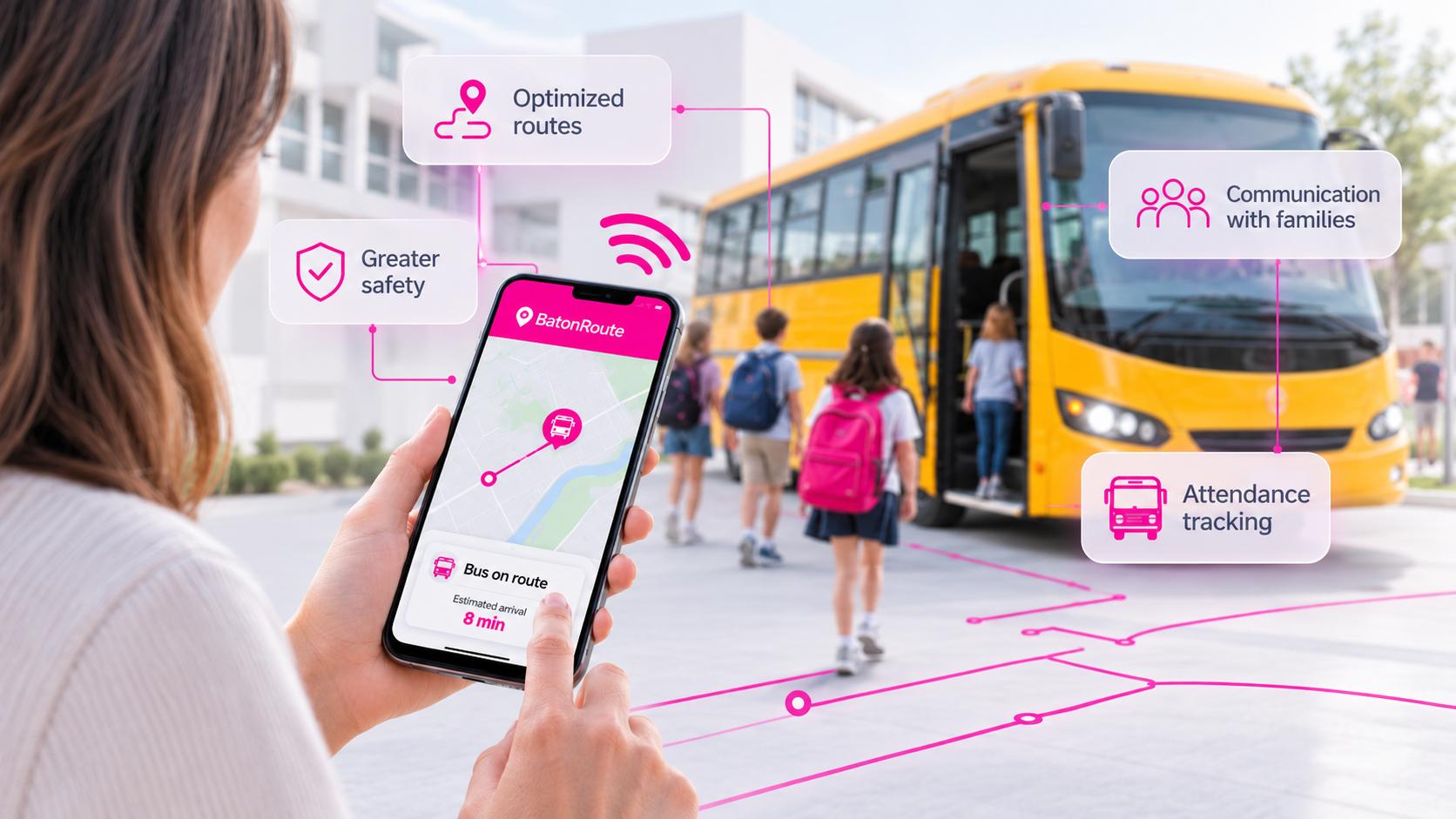
A school transport app makes it possible to centralise much of this communication. From their mobile device, families can check their children's schedule, see where the bus is, receive notifications about delays and report absences when the school enables this option. This brings three main advantages:
- More information: families can check the transport status without depending on phone calls.
- Less administrative work: part of the communications and notifications are handled automatically.
- Better coordination: the school, families and transport staff work with shared, up-to-date information.
Digital communication not only improves the experience for families, it also helps the school organise its resources better.
 -->
7. Do school buses need GPS devices installed?
Not necessarily. Some school transport management platforms can use the GPS built into the mobile phones of drivers or monitors. In this model, the person in charge of the route uses a mobile app that shares their location while the service is active.
This makes it possible to track the bus without installing dedicated devices in every vehicle or changing the existing fleet. It is an especially attractive option for schools that work with external transport companies and want to digitalise the service without major changes to their infrastructure. Before choosing a solution, check how its geolocation system works and what devices each user needs.
8. How to choose the best school transport software for a school
There is no single solution that suits every school. The choice will depend on the number of students, the characteristics of the routes, the available fleet and communication needs. Before signing up, we recommend considering these criteria:
| Criterion | What to check |
|---|---|
| Ease of use | That it is simple for school staff, drivers and families. |
| GPS tracking | That it lets you see where buses are during their routes. |
| Attendance control | That it records boarding, drop-off and absences. |
| Family app | That it lets families view information and receive notifications. |
| Route optimisation | That it makes it easy to plan efficient routes. |
| Integrations | That it can connect with existing school management tools. |
| Adaptability | That it works with different types of schools and transport models. |
| Implementation | That it does not require unnecessary changes to your infrastructure. |
| Technical support | That help is available during implementation and daily use. |
It is also advisable to request a demo of the platform and see how it handles real situations: a last-minute absence, a stop change or a delay during a route.
9. BatOnRoute: technology to digitalise school transport
BatOnRoute is a transport management and optimisation platform that helps schools, bus companies and organisations coordinate their mobility services. Its technology centralises route planning, vehicle tracking, attendance control and communication with families in a single environment.
Main features for schools
- School route management: route planning, stop assignment and organisation of students.
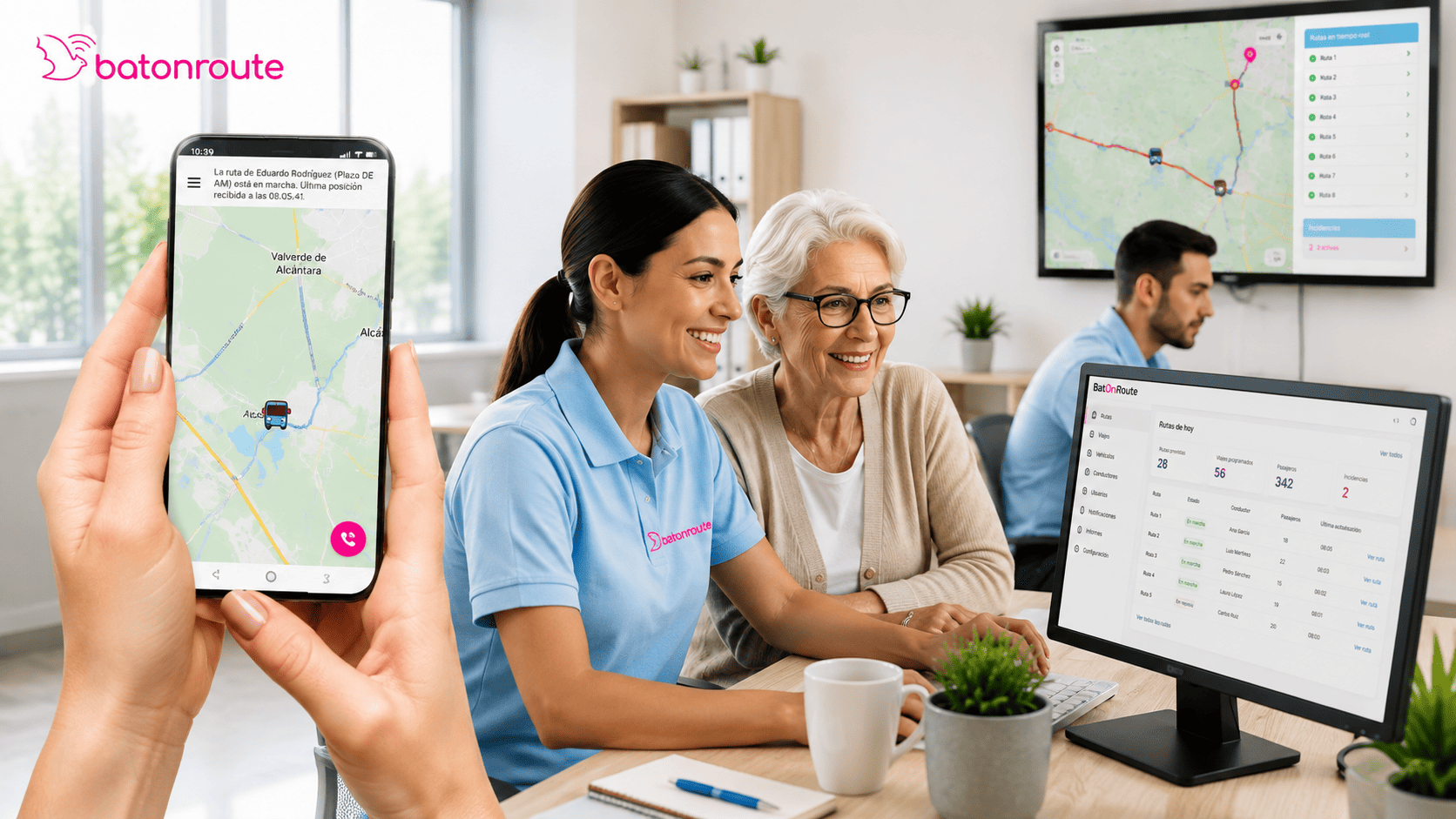
- Real-time tracking: bus locations viewed through the control app.
- Pick-up and drop-off control: recording of students boarding and getting off.
- Family app: access to transport information and notifications.
- Absence management: reporting the days a student will not use the service.
- Route optimisation: route calculation that takes the school's operational needs into account.
- Integration with education systems: connection with platforms such as PowerSchool, iSAMS, Clickedu and Alexia, among others.
One of its key features is that it does not require installing additional GPS devices on the buses: tracking is done through the GPS of the mobile device used by the person in charge of the route. BatOnRoute can also be implemented without changing the school's usual transport company.
The solution adapts to different educational models: public, private and international schools, schools with adapted transport, and other organisations that need to manage student journeys.
Want to find out how to digitalise transport at your school?
Discover everything BatOnRoute can do and how we can help you improve the planning, tracking and day-to-day management of school transport.
Discover BatOnRoute's solution for schoolsFrequently asked questions about school transport management
What is a school transport management system?
It is a technology platform for organising routes, managing students and stops, controlling attendance, supervising buses and keeping families informed during school journeys.
What are the benefits of digitalising school transport?
Digitalisation centralises information, reduces administrative work, improves route planning, helps control attendance and makes communication between schools, families and transport companies easier.
How can parents know where the school bus is?
Through a mobile app connected to the transport management system. Families can see the bus's location during the route and its estimated arrival time at the stop, as long as the school has these features enabled.
Is it possible to check whether a student has boarded the school bus?
Yes. Attendance control systems can record when students board and get off using mobile apps and other identification mechanisms, depending on the needs of the service.
Is it mandatory to install GPS on school buses?
Not necessarily. Some solutions, such as BatOnRoute, use the GPS built into the mobile devices of route managers to share the vehicle's location without installing additional equipment.
Can transport for several schools be managed from the same platform?
Yes. Some platforms let you manage different schools, routes, vehicles and users from a centralised environment, making it easier to oversee transport services with different characteristics.
Can school transport software integrate with the school's management system?
Yes. Some platforms offer integrations with educational tools and school management systems to make information exchange easier and avoid duplicating administrative tasks.