Employee transportation management in large companies and industrial parks is one of the main operational challenges in complex corporate environments. When multiple shifts, different pick-up points, and large volumes of workers are involved, corporate transportation stops being a secondary service and becomes a key factor in productivity, efficiency, and sustainability.
Optimizing corporate transportation not only reduces operating costs, but also improves punctuality, enhances the employee experience, and reduces the organization’s environmental impact.
Challenges of Employee Transportation in Large Organizations
Corporate transportation management in large companies presents specific challenges:
-
Coordination of multiple routes and stops.
-
Adapting services to different work shifts.
-
Low occupancy during certain time slots.
-
Lack of real-time visibility.
-
Limited data analysis capabilities.
-
Increased costs due to unproductive mileage.
In industrial parks located far from urban centers, these issues intensify, making it essential to implement specialized technological tools for route optimization for companies.
How to Optimize Employee Transportation in Large Companies
1. Intelligent Route Planning and Optimization
Corporate route optimization must go beyond simply selecting the shortest path. It requires analyzing:
-
Employees’ geographic locations.
-
Area-based clustering.
-
Schedules and shifts.
-
Vehicle capacity.
-
Occupancy rates.
-
Traffic and external conditions.
Applying advanced planning solutions such as BatOnRoute enables companies to:
-
Reduce total kilometers traveled.
-
Lower operational costs.
-
Improve punctuality.
-
Increase overall transportation efficiency.
Proper corporate transportation optimization can lead to significant reductions in costs and emissions.
2. Digitalization of Corporate Transportation
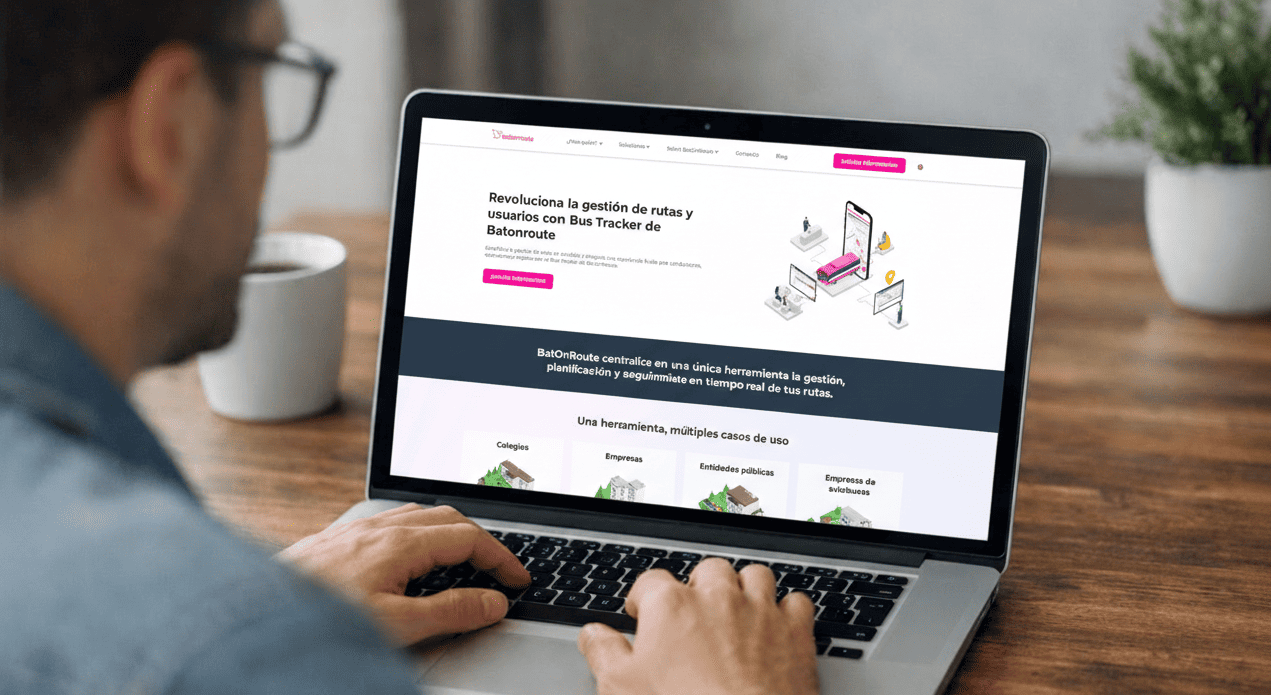
Digitalization is the central pillar of efficient transportation management. Implementing a technological platform allows for:
-
Centralized management of users and stops.
-
Automatic route assignment.
-
Attendance tracking.
-
Direct communication with employees.
-
Dynamic updates in case of incidents.
Digitalizing employee transportation eliminates manual processes, reduces errors, and provides full service traceability.
3. Real-Time Monitoring and Tracking
Real-time monitoring of corporate transportation is essential in industrial environments with strict schedules.
Key benefits include:
-
Punctuality control.
-
Early detection of delays.
-
Fast resource reallocation.
-
Automatic notifications to employees.
-
Greater service transparency.
Integrating GPS technology into a management platform transforms operational data into strategic decision-making insights.
4. Flexible and Demand-Responsive Transportation
Not every day has the same occupancy levels. An optimized system should include:
-
Dynamic vehicle allocation.
-
Integration of on-demand transportation.
-
Rapid route reconfiguration.
-
Elimination of underutilized routes.
Flexibility improves system profitability without compromising service quality.
5. Data Analysis and Continuous Improvement
Advanced corporate transportation management requires clear performance indicators:
-
Cost per transported employee.
-
Occupancy rate.
-
Average punctuality.
-
Optimized kilometers.
-
CO₂ emissions reduction.
-
Employee satisfaction level.
Continuous analysis enables companies to detect inefficiencies and make data-driven decisions.
Benefits of Optimizing Employee Transportation
1. For the Company:
-
Reduced operational costs.
-
Increased productivity through improved punctuality.
-
Achievement of sustainability objectives.
-
Enhanced corporate image.
-
Data-driven strategic planning.
2. For Employees:
-
Greater comfort and safety.
-
Real-time information access.
-
Reduced commuting stress.
-
Improved work-life balance.
Optimized corporate transportation directly impacts the overall efficiency of the organization.
Corporate Transportation as a Competitive Advantage
In large companies and industrial parks, employee transportation is a strategic component of daily operations.
Implementing intelligent corporate transportation management solutions based on route optimization, digitalization, and data analysis transforms a complex system into an efficient, sustainable, and scalable model.
Investing in employee transportation technology is not merely an operational expense; it is a strategic decision aimed at productivity, efficiency, and competitiveness.